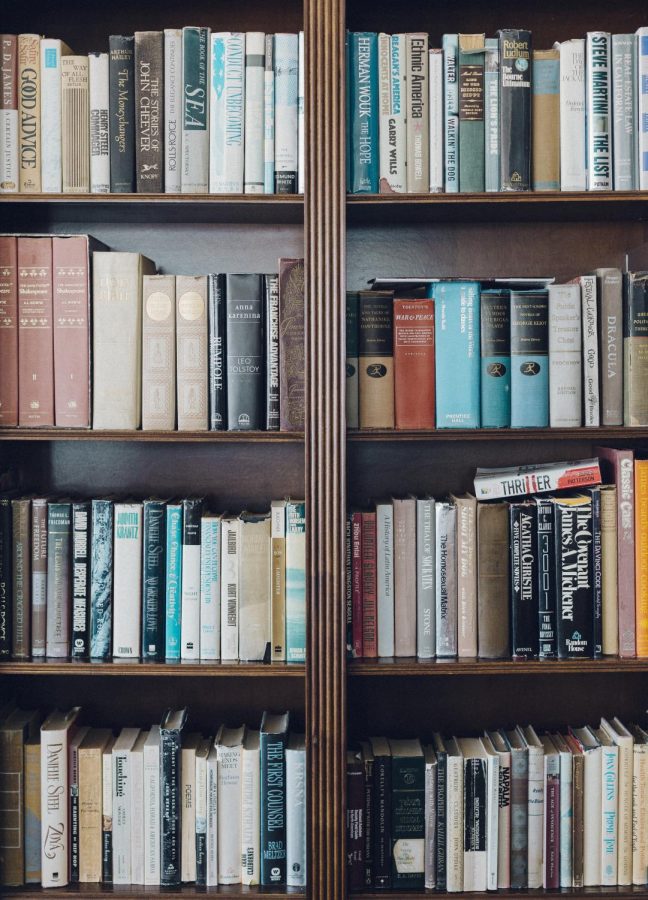
The AP Literature project is a tradition that has been altered with the onset of the Covid-19 pandemic
During a normal school year, CHS students can be found in the library quietly eating smuggled chips, frantically finishing homework due the next period, and whispering about the dreaded author project. The author project is a 10-15 page long research paper centered around the works of a specific author. CHS students have the opportunity to complete two author projects during their high school career: one in Honors American Literature junior year and one in AP Literature senior year. The junior year project focuses on American authors and how they fit into the literary canon. The senior year project includes authors from around the world and the topic of the paper is completely up to the students. This year, the pandemic has provided a huge obstacle for students writing their author paper.
Initially, AP Literature teacher John Ryan feared that because of the new level of independence of the project due to social distancing, students would struggle to access all the resources necessary to write high quality papers. However, the hurdles of remote learning proved to be an opportunity for growth and creativity for students.
For senior Emma Wilson, the pandemic allowed her to focus on the paper itself rather than the grade.
“Since the end of sophomore year, I’ve been trying to learn for the sake of learning. I think that’s a big thing in Clayton that each student finds themselves battling – do I have the time to actually understand the material, or will I just memorize it for the test and be done? The pandemic made it so much easier for me to stop putting so much pressure on myself to outperform myself on each assignment. The pandemic allowed me to take away all my restrictive expectations, which actually made my work turn out better,” said Wilson.
Typically, AP Literature students begin researching for their author project at the end of junior year. Students read three of their author’s most famous works over the summer then read critical sources and a final book by their author over the fall. Finally, they start drafting their paper and conferencing to create a finished product. This year, students were only required to read three books by their authors and the number of critical essays they were required to read were also limited. Although students were required to read fewer works by their authors, Ryan does not believe this had any impact on the quality of their work.
“I definitely had a few moments of like, ‘this is going to deeply affect the project’ but it didn’t. […] I want to emphasize that I don’t think it affected the quality as much as I thought it might. People still produced essays that I would put up against any number of essays that were done traditionally in past years,” said Ryan.
Students were able to conference the papers with Ryan multiple times throughout the project over Zoom. Although these conferences lacked face to face interaction, some students found them more helpful than traditional conferences.
“Once we started conferencing, I began to really like getting notes in a virtual setting. Mr. Ryan would leave comments directly on the document and then I could look at them with him and ask questions about anything that I was not sure about,” said senior Cavan Helmering.
The ability of students to complete the project independently is a testament to the growth CHS English students experience during their four years of high school. “[The authors project is] a culmination of years of your work, and that includes the teachers you had in the conference writing program, all along,” said Ryan.
Besides providing a capstone research project for students to practice important researching skills, the author project also allows students to connect to the authors they read. Many students are affected by the works they read.
Senior Pablo Buitrago enjoyed reading his author Jorge Luis Borges’s works.
“Borges’s works are a lot of fun to read, but they also have great philosophical questions which leave you thinking for many hours after you’ve put his books down. I actually ended up writing my Common App college essay about how Borges’s work impacted my understanding of human perception and ‘reality’,” said Buitrago.
Senior Noah Kennedy was also grateful to read his author Joseph Conrad’s books.
“I think as a result of writing the paper I gained a changed outlook on life. My argument had a lot to do with how the individual’s worldview is influenced by external factors. Now, I find myself looking inward, and realizing especially in the face of Covid-19 the ways in which my worldview is influenced by my situation. I don’t think any of us can trust ourselves fully now. We’re in an awful situation, and our minds are more likely to turn to bleak thoughts as a result. We have to recognize that, and know that even if we can’t see it, there’s light at the end of the tunnel,” said Kennedy.
Although the pandemic has provided many obstacles to learning, the author project was a resounding success.
Support student journalism! A donation of $50 or more includes a subscription to the Clayton High School Globe 2026-2027 print news magazine. Once you have completed your donation, please email [email protected] with your home mailing address so we can ensure you never miss an issue.
We will mail a copy of our issues to the recipients of your choice.
Your donation helps preserve the tangible experience of print journalism, ensuring that student voices reach our community and that student democracy thrives.
Sofia is a senior and is Editor-In-Chief of the Globe this year. She started Globe because she is interested in writing and exploring different issues in the Clayton community....
Donate to The Globe
$0
$600
Contributed
Our Goal
Submitting donation...
Dear Donor,
On behalf of the entire Globe staff, thank you so much for your generous donation.
Your support comes at a thrilling time for our publication. Last year, through the incredible support of our donors, we were able to provide a free copy of The Globe to every single student and staff member at Clayton High School who wanted one on distribution days. Our goal is to continue this tradition for the 2026-2027 school year, and your gift brings us one step closer to making that happen.
We believe that local, timely, and thought-provoking student journalism builds a stronger, more informed community. Thank you for investing in our students, our stories and our vision.
Warm regards,
The Globe Staff
There was an issue submitting your request.
Comments (0)
The Globe is committed to fostering healthy, thoughtful discussions in this space. Comments must adhere to our standards, avoiding profanity, personal attacks or potentially libelous language. All comments are moderated for approval, and anonymous comments are not allowed. A valid email address is required for comment confirmation but will not be publicly displayed.