


Students are not as sleep-deprived as parents think they are, according to the Department Chair of the Health and Physical Education Department and health teacher, Sarah Gietschier-Hartman.
“Do we have some students who are probably struggling with their sleep due to a number of factors? Yes. Do we have students who are staying up way too late on devices when they really should be asleep? Yes,” Gietschier-Hartman said. “[But also,] do we have some students who are incredibly responsible with their sleep and have a really consistent sleep schedule? Yes.”


According to an article in the National Library of Medicine, teenagers, during those in-between years, undergo biological changes in their sleep patterns, which Gietschier-Hartman believes can be confusing for parents trying to help their children with their sleep.
“Sometimes adults think, ‘Oh, well, because you don’t follow the same schedule as  me, you must not be doing it right,’ which isn’t the case at all,” Gietschier-Hartman said. “[My students and I] start to get a lot deeper into concepts of sleep that most of my students have never heard of before, which is pretty cool. I’m really teaching them something new, and they seem really interested in it in class.”


 One such topic is the idea that genetics, more specifically a person’s chronotype (someone’s “natural inclination, with regard to the times of day, [of] when they prefer to sleep or when they are most alert or energetic,” according to Oxford English Dictionary), determines whether someone has more energy in the mornings or the evenings. During their teenage years, most people shift towards energy in the evening, and then sometime in their mid-twenties, individuals revert to their genetic tendencies.
According to Gietschier-Hartman, whose sleep curriculum is supported by the book “Sleep: The Myth of 8 Hours, the Power of Naps, and the New Plan to Recharge Your Body and Mind” by Nick Littlehales, hours are not the best way to track your sleep. The body sleeps in 90-minute sets called sleep cycles. Most people get between four and six sleep cycles per night, and to feel the most refreshed in the morning, you do not want to wake up in the middle of one.

“My students use clocks and use the information that they’re learning about sleep cycles to develop potential sleep times and wake times for them that will allow them to get enough cycles across a seven-day period or a week,” Gietschier-Hartman said. “Instead of measuring sleep in hours, which is [where] we often see [that] teens aren’t getting enough sleep, we focus on how many cycles you can get across a week.”
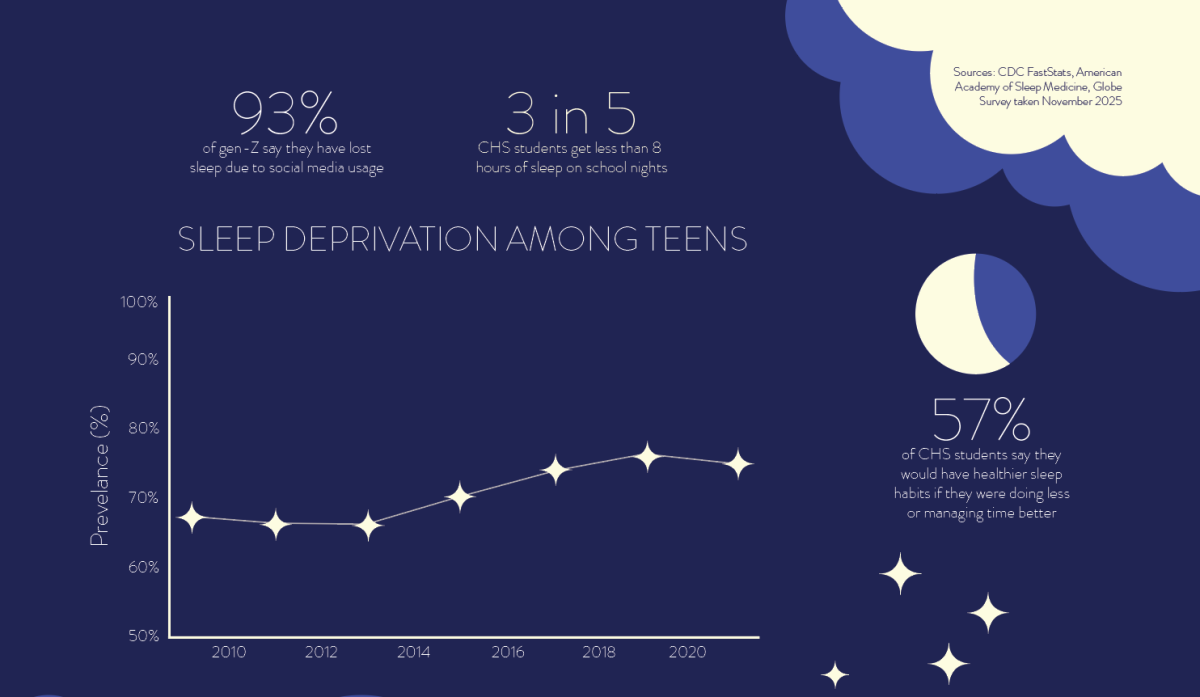
It is recommended for teenagers—and adults, but differently because as you age, your sleep needs change—to get between 35 and 42 sleep cycles per week, with closer to 42 being optimal for teens. This allows teenagers more flexibility in their sleep schedules than adults have. Teens can stay up later one night and make it up a day later by sleeping in or going to bed early to maintain the ideal number of cycles per week.

“[Students might] miss one of [their] sleep cycles and go to bed an hour and a half later than [they] usually do, but when [their] alarm goes off in the morning, it’ll go off at the end of a sleep cycle, [so they’ll] feel a lot more refreshed than if [their] alarm went off when [they were] still in deep sleep,” Gietschier-Hartman said. “You could make up for it the next night by getting an extra cycle or sleeping in on the weekends.”
Gietschier-Hartman has found that in her class, students’ optimal sleep schedule is close to what they already achieve.
“I end the class with the question, ‘How close is this to your real life schedule?’ Almost all of them say, ‘This is really close.’ [They say that ‘My actual sleep patterns are] within 20 minutes, 15 minutes, or half an hour [of the hypothetical ideal sleep,]’” Gietschier-Hartman said. “It’s not that they’re not getting enough sleep. It’s that teenagers sleep completely differently than every other age group.”
Sophomore Sandy Martyn, a student of Gietschier-Hartman, has observed a culture among students of boasting about their lack of sleep.

“Sometimes people get to school, and they’ll be like, ‘Oh, I’m so tired.’ [or] ‘I was up till 2 a.m.’ And I’m like, do you want to be? I feel like that’s not something to brag about, because whenever that happens to me, I feel awful the next day,” Martin said.
Additionally, Martyn changed her sleep habits because of the class, focusing more on sleep cycles than before.
“The cycles are what make you feel more rested in the morning. [I’ve changed my alarms] because you’re supposed to wake up on that 90-minute interval, which sounds counterintuitive, because you’re waking up earlier, so you’d feel worse. But I think it’s helped me a lot. When I get to school, I’m more refreshed,” Martyn said.
The culture at school surrounding sleep varies from person to person; some people sacrifice sleep for academics, while others maintain a healthy balance.







justin • Feb 3, 2026 at 11:40 am
In scientific research, the experimental group receives the treatment or independent variable being tested, while the control group receives no treatment, a placebo, or a standard treatment