

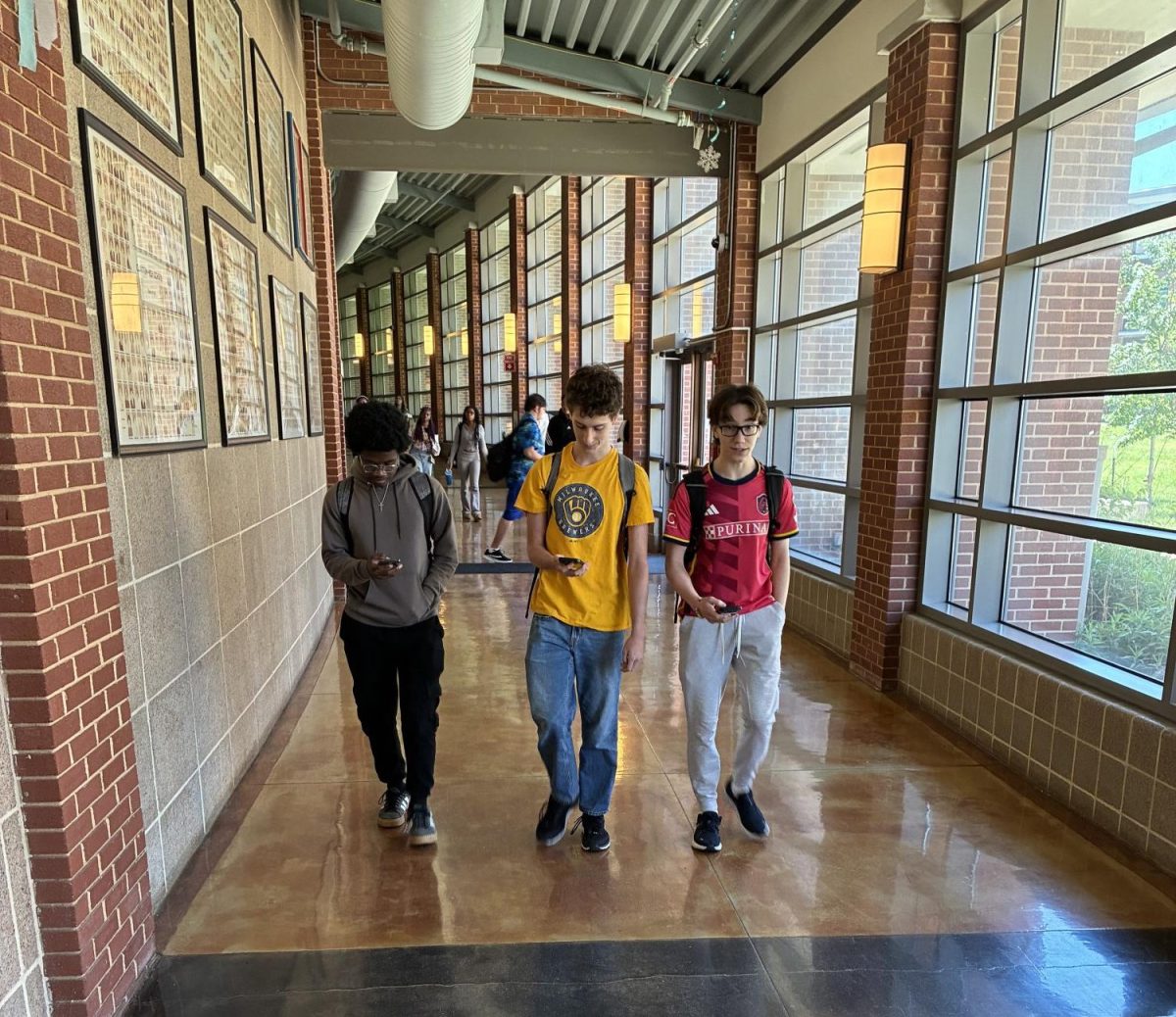
A year ago, students walked through the hallways with their heads buried in their phones. Today, students and administrators are seeing both the benefits and challenges of Missouri’s statewide cell phone ban.
“There was a significant concern at the beginning [of the year] about whether the juice was worth the squeeze, but I think the responses from teachers have been that the classroom environment has been much better to teach and learn in, because there are fewer distractions,” Principal Dan Gutchewsky said.
While students understand the importance of keeping phones away during class, they have a more negative view of the policy’s approach to downtime.
“My initial thoughts were [mixed]. It’s good to get people off their phones, especially during learning periods, but it’s also just a bit annoying when you’re in a passing period, or you have a free period, and you have downtime,” junior Thomas Yoon said.
In addition to concerns about whether the policy would be worth it, some wondered if the state should have left it to districts to create their own policy.
“I’m almost always in favor of local control of school districts, but this is one [situation] that made it easier on people. It provided consistency across the state,” Gutchewsky said. “I’ve been in other high schools for various professional things; there’s quite a variance on how schools enforce the state law, but this is one of those situations where it made [the transition] pretty easy,” Gutchewsky said.
While administrators believe the policy has yielded positive results, they are hopeful of marked improvement next year. However, students see the policy as being less effective.
“I don’t think it’s been that effective because there are teachers who aren’t super strict about it, and even if they are, it’s pretty easy to hide a phone. I personally haven’t seen a decrease in the frequency of phone use,” Yoon said.
Verbal warnings are the most common consequence of phone use, but they are only one part of the policy; confiscations have also been a part of the new state policy.
“We had more confiscations in the first semester than we had the entire time I’ve been at Clayton High School. Now, granted, the rules are certainly different. [Over the course of the year, we have confiscated] around 250 [phones], whereas last year, we ended the year with less than 50,” Gutchewsky said. “Now, they’ve tapered off. I don’t know if it’s because people are learning their lesson as much as there’s enforcement fatigue, and people being sneakier.”
This enforcement fatigue is often not due to teachers not taking phones at all, but stems from stricter enforcement in other areas.
“I think [teachers] are focusing on the learning spaces, more than public spaces and I think some of that comes from [the process requiring] additional time to turn in the phone and talk to an administrator. So I think that [teachers and administrators] are really focused on the classroom environment,” Gutchewsky said.
The confiscation of phones during class makes sense to most students. However, some believe that confiscations at lunch are too extreme a punishment.
“[Phone confiscation] makes sense, because if you’re on your phone during class and it’s disruptive, you get your phone taken. They tell you in every class to keep your phone away, and you should have it taken because you shouldn’t have had it out in the first place,” junior Michael Evra said. “But my friend [had his taken] at the lunch table, and that is a little extreme to take it at lunch.”
Gutchewsky reported that earlier in the semester, upperclassmen were the most frequent offenders.
“It was less of a shock for the freshmen than it was for the upperclassmen,” Gutchewsky said. “We have some chronic offenders, but usually it takes one confiscation, and it doesn’t happen a second time.”
Most of the criticism from students has centered on the policy’s ban on phones outside of class time, which some argue conflicts with the open campus policy.
“My philosophy is that we have education going on inside the building, but we are more than just the learning that’s happening here. How are we helping young people grow and mature so they’re making positive choices? When our students go into the workforce, or when they go to college or university, it’s going to be up to them to make positive, personal choices about how to use those phones,” Spiegel said. “We are very exceptional as a school to have an open campus policy, allowing students to take advantage of [that policy], and stepping outside to make an important call at appropriate times is valuable.”
Evra likes the idea of preparing students for college and for life after high school.
“[The phone ban] can be beneficial by helping students with social skills. At college, there are a lot of different places on campus, and you don’t want to just sit in the corner and be on your phone,” Evra said. “That’s what I kind of see with not having your phone at lunch to try and have conversations with people and [build] your social skills.”
As with any policy, there are often learning curves, but administrators believe that the students and staff have done a good job adapting and will continue to do so.
“There is a learning curve,” Spiegel said. “We have to recognize that there’s work to be done in learning how to manage when it is okay and not okay to use technological devices to further education. I appreciate all the work that our staff and our students do to help with the policy.”







![Dorsey teaches his third-period geometry class on Thursday, April 9. "I enjoy that [the students] are willing to get up, work at the whiteboards and collaborate," Dorsey said.](https://www.chsglobe.com/wp-content/uploads/2026/05/IMG_9493-868x1200.jpg)