
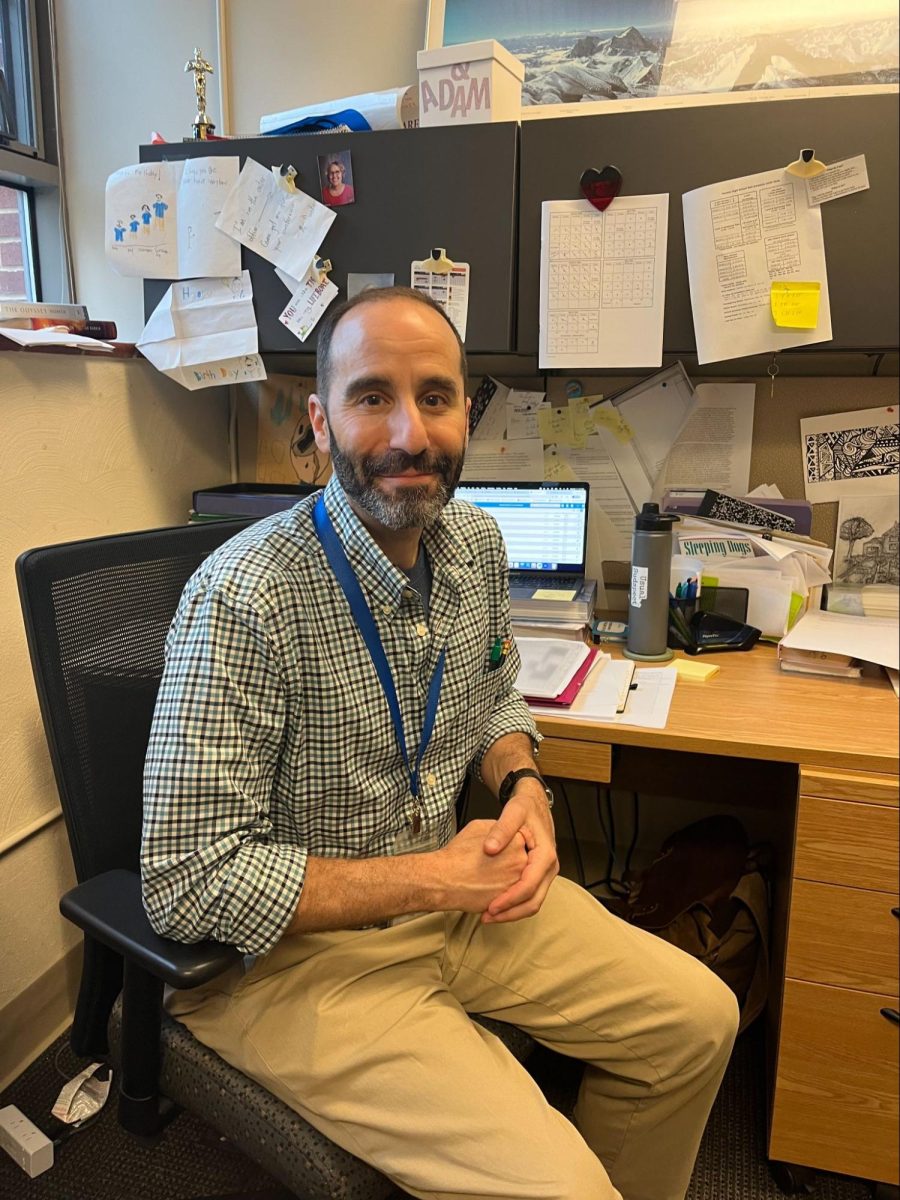
Adam Dunsker never gave much thought to statues or plaques. But as he prepares for his final English conferences, a 30-year career spanning three schools and thousands of students serves as a record of his time in the classroom.
Dunsker had not originally considered teaching at Clayton; it was a phone call from a former boss that led him to teach here.
“It worked out really nicely. We were getting ready to move to University City. We had been living in West County, and as we’re getting ready to move and think about what we’re going to send the kids to school,” Dunsker said.
A former department chair who had moved to Clayton the year prior called to share that there were two openings at Clayton.
“The department chair at the time had asked if [I] knew people who were good teachers at Lafayette, and he shared with me that he gave them my name,” Dunsker said. “ I applied, and I was lucky enough to get the job.”
Having spent his entire career teaching ninth and 10th grade, Dunsker finds working with this age group particularly fulfilling.
Dunsker often sees these skills shine when students choose the free write option for their English compositions.
“I enjoy it when I offer a creative writing option, and students choose that. I’ve been impressed with the work that students come up with, whether it’s a dystopian short story or my ninth graders sometimes write a new ending to “Lord of the Flies.” Giving students a chance to do creative writing has often borne impressive fruit,” Dunsker said.
Dunsker realizes that, at the moment, it is hard to know whether you are having an impact on students’ futures.
“My approach has been to try to meet people where they are and to move forward with them to the degree possible. The thing that I’m proudest of is when I look back, over 1000 students in my career, maybe 2000, and I hope, for the majority of them, I’ve been able to contribute something. One of the things about teaching is that we don’t always know if we’re having the impact that we want to,” Dunsker said.
Despite this uncertainty, Dunsker hopes his students look back on his time teaching them and realize that, though they did not always enjoy the material, it was useful.
“Most adults can tell a story about a time they thought they were treated unfairly when they were 14,15 or 18, and they were sure they were right,” Dunsker said. “Then in their 40s, they look back on that moment and say, ‘Oh my gosh, my parents or my teacher actually did have my interest at heart, and they were trying to show me something, and now I get it.’ I hope I’ve planted seeds that even if the students didn’t always make sense, even if I wasn’t able to help the students see the good sense of what I was trying to do in the moment, that years later, a student will say, I did learn something in that class,” Dunsker said.
Junior Drew Garfinkel learned this lesson from Dunsker before leaving high school.
“He did these vocab [quizzes] where you had to learn vocab, and at that moment, I was like, ‘This is dumb. I don’t want to do this.’ But looking back, I’m glad I did, because it helped with the SAT. Several words [he taught us] were on the SAT,” Garfinkel said.
Teaching students vocabulary is not the only thing for which students are thankful to Dunsker.
“You read 250 pages per quarter, [which] inspired me. The two books I read gave me perspective and got me to read, even when I didn’t have to,” junior Seamus McDowell said.
A favorite pastime among students is speculating about Mr. Dunker’s personal life. While some of his hobbies are exactly what you would expect, others are entirely unpredictable.
“I read, and actually, a couple of years ago, I started making soap. This past summer, I started selling at farmers’ markets. That’s something I’m going to do to keep me busy in retirement,” Dunsker said. “That’s helped teach me patience, because it’s a process that takes a little while, and then even once you mix up the soap, it takes a couple of days before it’s ready to be sliced, and then it takes six weeks to cure before I know whether it works the way I wanted it to,” Dunsker said.
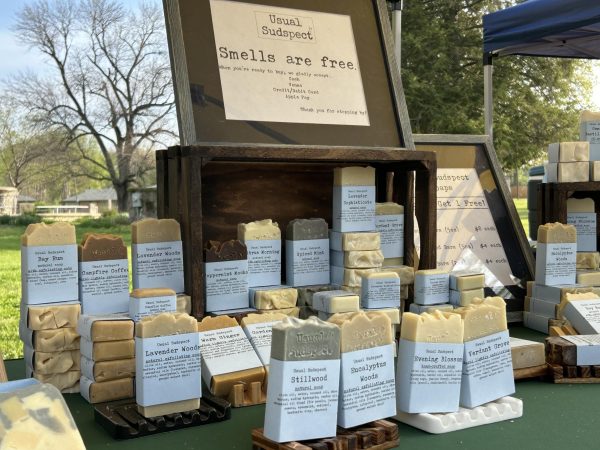
This patience, he says, is something he has developed throughout his time teaching.
“Over the course of 30 years, I’ve become more patient. I bet I’m better than I used to be at listening to people and trying to understand where they’re coming from and what they need, even if the way they’re saying it doesn’t sound like they’re asking for help at that moment,” Dunsker said.
When Dunsker thinks about his legacy, he does not think of it in terms of statues or plaques, but rather in terms of his impact on students and coworkers.
“I don’t worry about a legacy in that sense, I think we all leave some kind of legacy on the people we’ve known and worked with. It doesn’t have to be gilded or carved into stone,” Dunsker said. “I hope my colleagues look back and know that I always supported them and that I enjoyed my time here. I hope my students can look back and feel like I have contributed something to help their success in the future.”
![Registrar Lois Stiegemeier gives her daughter an inspirational speech to remind her of the uniqueness of every human, that she has higher significance to this world then she realizes. As a parent, Stiegemeier wanted to ensure her children went into the world with a positive attitude. “You are worth more than you [know]. Don't settle for less,” Stiegemeier said.](https://www.chsglobe.com/wp-content/uploads/2026/05/Screenshot-2026-05-18-11.27.23-AM.png)
![Sophomore Adam Gallegos walks his first-ever runway for Dolce & Gabbana. “When I saw a picture on the Vogue website of me, [I thought] this can't be me. This can't be real,” Gallegos said. “That picture to me will always be crazy.” Dolce & Gabbana Fall 2026 Menswear Look 51 / 100
Photo by Isidore Montag, Vogue, ©Condé Nast](https://www.chsglobe.com/wp-content/uploads/2026/04/image4-960x1200.jpg)
![Dorsey teaches his third-period geometry class on Thursday, April 9. "I enjoy that [the students] are willing to get up, work at the whiteboards and collaborate," Dorsey said.](https://www.chsglobe.com/wp-content/uploads/2026/05/IMG_9493-868x1200.jpg)