
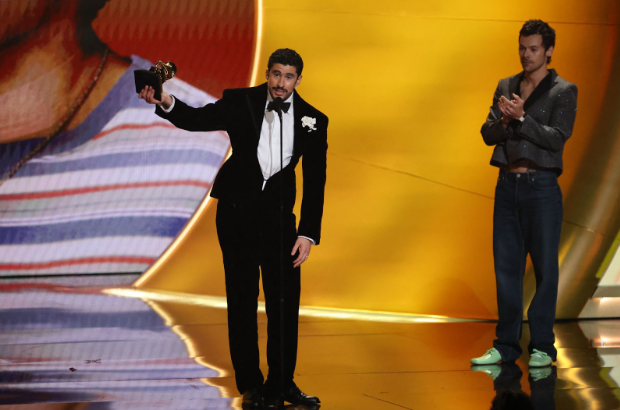
Debuting in 2013, Bad Bunny began his music career as a SoundCloud rapper, releasing songs while working as a grocery bagger, leading to his signing with his first record label, “Hear This Music,” three years later.
Soon, he began releasing “X 100PRE,” his debut studio album, as his fame grew into six Grammy wins, including the first Album of the Year award given to a Spanish-language album, “Debí Tirar más Fotos,” and the headliner spot of the Super Bowl halftime show.
“I think the artist [Bad Bunny] is bigger than America even perceives him as; he’s a global phenom, really. He’s quite the music artist, quite the artist internationally,” Spanish teacher Nathan Fouquet said.
As a six Grammy Award winner, 17-time Latin Grammy Award winner, eight-time Billboard Music Award winner, and 13 Lo Nuestro Awards winner, Bad Bunny has redefined global pop. His upcoming Super Bowl performance will be headlined entirely in Spanish.
“We are a diverse country, we have a diverse population, and we have a significant number of Spanish-speaking people who are, in the media, vastly underrepresented. I feel like this gives them a voice and a face and some presence on one of the biggest stages of media,” Fouquet said.
The announcement of Bad Bunny as the Super Bowl LX headliner has been polarizing, drawing criticism from conservatives, including Donald Trump and House Speaker Mike Johnson. Most of this backlash stems from Bad Bunny stating that he would perform entirely in Spanish, a first for a solo performer in Super Bowl history.
“It doesn’t really matter too much if it’s in English or not. […] I think it would be nice to have that kind of representation,” freshman Molly Spees said.
The popularity of Bad Bunny and his commercial success reflect a change in mainstream media culture and consumption in the United States, as Spanish-language media has become increasingly popular and more central to U.S media with the growth of the Hispanic and Latino population of the U.S, which now represents 20% of the entire U.S population. This is evident in commercial data, such as tour data and revenue. For instance, Spotify reported that Bad Bunny was streamed 19.8 billion times in 2025. And Bad Bunny’s Puerto Rico residency from July 11 to Sept. 20 of last year generated $200 million for Puerto Rico’s economy through ticket sales and a massive tourism boost.
“Many of our students have heard of him outside of class as well due to his increased popularity,” Spanish and Pop Culture in Latin America teacher Amy Dean said.
Clayton is a community with varied opinions on the scope of artists such as Bad Bunny in United States culture and in Clayton culture.
“We live in a little bit of a bubble in Clayton […] I don’t know if it’s making the ripple here, in my perspective, if it’s making the ripple here that it is in other parts of the world,” Fouquet said.
Teachers in the foreign language department have even used Bad Bunny’s music to support students’ learning and increase engagement.
“He’s [Bad Bunny] one of the top performing artists in the world right now, and we’ve used his music in class frequently to get students excited about what we’re learning,” Dean said.
Dean said students have actually asked if they can do more Bad Bunny lessons in class.
“Students want to know what young people in other countries are listening to, and that helps them find new ways to connect to what we’re learning in class,” Dean said.
Freshman Genevieve Nguyen was less acquainted with the music of Bad Bunny, but tended to agree that he was well-known and influential in parts of the community.
“I have [heard of Bad Bunny]. I’ve seen him collab with other artists, but I don’t really listen to his music,” Nguyen said. “I think that’s [Super Bowl halftime show is] really cool. Especially with the state that the world is currently in, I think it’s very good representation.”
Spees believes that a large part of the importance of Bad Bunny’s performance and representation for the Hispanic and Latino communities is the message of remaining strong that it sends to the rest of the world.
“It reminds me [of] a little bit is when Russia started invading Ukraine, and instead of fleeing the capital, Zelensky and all of his politicians made it very clear that they’re not going anywhere. It reminds me of that, and I think it’s good to have that kind of representation,” Spees said.
Building on the historical context, Fouquet argues that the current visibility of Latino and Hispanic communities marks a departure of the past is in media culture.
“We’re more diverse than what we have historically seen represented in TV shows, music, and things are getting better. Shakira was part of the halftime show a while ago,” Fouquet said. “I think we’re trending in the right direction. Our community [is] better represented in the media, in a more realistic way. It just continues to establish that, although it’s not where it needs to be, and it probably won’t be anytime soon, it’s definitely moving in the right direction.”

![Registrar Lois Stiegemeier gives her daughter an inspirational speech to remind her of the uniqueness of every human, that she has higher significance to this world then she realizes. As a parent, Stiegemeier wanted to ensure her children went into the world with a positive attitude. “You are worth more than you [know]. Don't settle for less,” Stiegemeier said.](https://www.chsglobe.com/wp-content/uploads/2026/05/Screenshot-2026-05-18-11.27.23-AM.png)


![Sophomore Adam Gallegos walks his first-ever runway for Dolce & Gabbana. “When I saw a picture on the Vogue website of me, [I thought] this can't be me. This can't be real,” Gallegos said. “That picture to me will always be crazy.” Dolce & Gabbana Fall 2026 Menswear Look 51 / 100
Photo by Isidore Montag, Vogue, ©Condé Nast](https://www.chsglobe.com/wp-content/uploads/2026/04/image4-960x1200.jpg)
![Dorsey teaches his third-period geometry class on Thursday, April 9. "I enjoy that [the students] are willing to get up, work at the whiteboards and collaborate," Dorsey said.](https://www.chsglobe.com/wp-content/uploads/2026/05/IMG_9493-868x1200.jpg)