
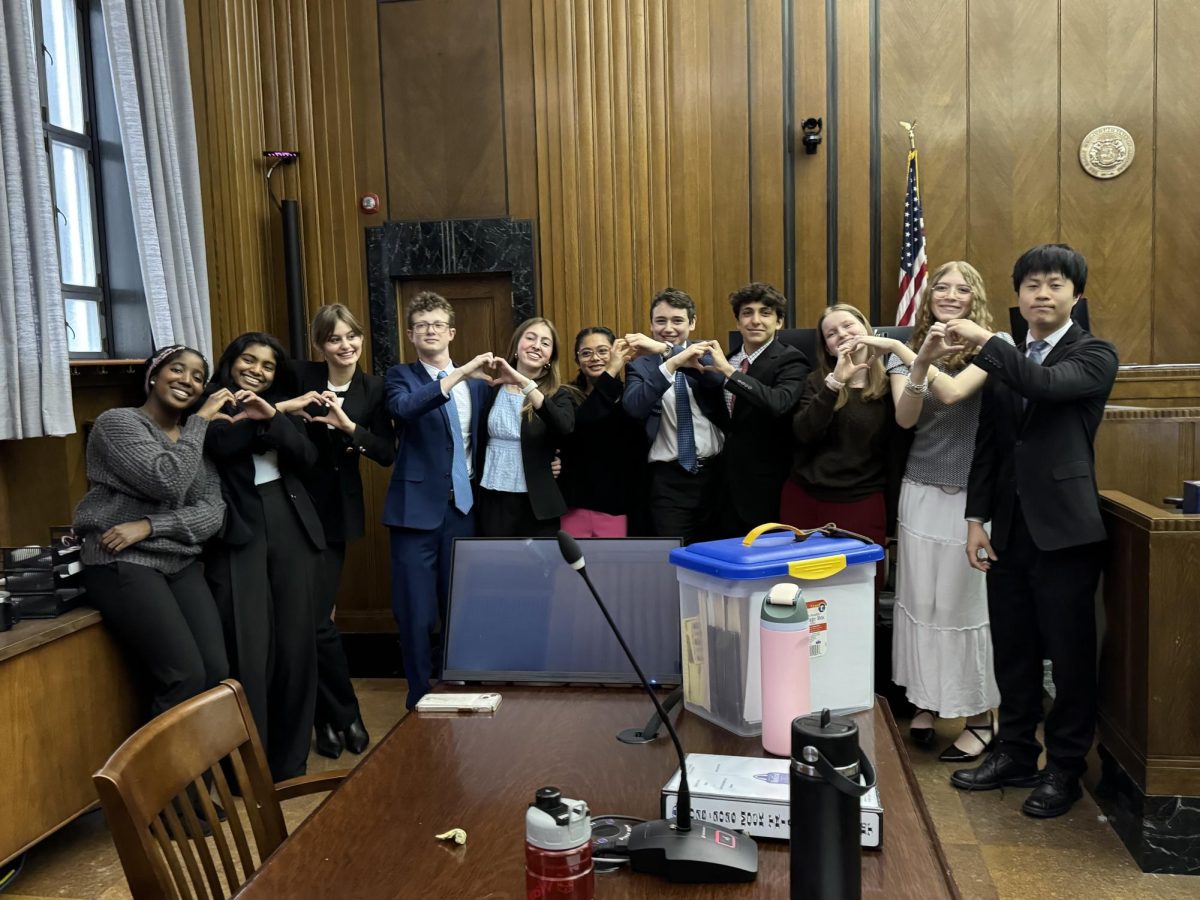
Imagine one single club that has debates, crying, laughing and celebrating in just an hour. Well, that’s the Mock Trial club, a diverse and intense speech and debate-esque club.
“Mock Trial Club is an 11-person team of students who form a team based on a legal case given at the beginning of the year. The team of witnesses and lawyers then conducts that same court case against other schools,” freshman Emillio Lowder said.
A new case is introduced each year, alternating between civil and criminal cases. Last year, the team was put on trial, in which the court determined whether they were guilty or not guilty.
“It was a murder charge as there was a rivalry going on between two mock trial coaches. One allegedly poisoned the other by giving him an allergic reaction to sesame seeds,” senior Elena Piston said.
A civil case is a case in which the court decides who is at fault for a particular incident. Those cases often end in settlements rather than imprisonment.
“The defendant this year was Adventure Holdings LLC, and the plaintiff was Kennedy O’Neill. Kennedy O’Neill was the parent of James O’Neill. James O’Neill was killed when he fell off the flood ride at the amusement park Dragon’s Bay,” junior Lelah Lee said.
The team acts as both the defendant and the plaintiff.
“The whole case was about whether James had unbuckled his seat belt and purposely stood up [on the ride], or whether there was something wrong with the seat belts,” Lee said.
There are many roles to take on within the team, as members can be both lawyers and witnesses. Meaning they worked on their argumentative skills or honed their acting talent.
“I was a defense attorney. I conducted a cross-examination of a plaintiff witness named Alex Hudson, who was a veteran Missouri Department of Safety Inspector, and then a direct examination of one Miss Parker Gillam, who is a friend of the victim,” Lowder said.
A direct examination, or DX for short, is when a Lawyer asks their witness partner open-ended questions to bring out certain details and facts about the case that either aid their case or hurt the opponent.
“I was stressed out about my direct [when I first competed], but I told myself [that] I know my direct. I practiced it a bunch of times, and my lawyer told me that I was going to do great, and that trust really helped,” Lee said.
Witnesses are also subject to cross-examination, in which the opposing team’s lawyers ask leading questions to undermine the witness’s credibility and damage the other side’s case.
“Cross was a time to be really witty and avoidant. I started looking forward to doing that, [as] it was teaching me a lot of skills. While I didn’t know what kind of questions they were going to ask me, I knew how to answer and avoid them. So I just started looking forward to it,” Lee said.
However, witnesses are not left to defend themselves; their lawyers can object to specific questions during both direct and cross-examination.
“When people object to me, I like it because I can shut them up with rule numbers and arguments,” Lowder said.
The objections come up randomly, and the objecting lawyer and the objected-to lawyer get to respond directly to the judge, who then decides, based on the arguments, whether the objection applies.
“When you’re on the stand, and someone makes an objection, your lawyer might have no clue what to say, and you’re just looking at them, trying to telepathically communicate what the right response is. But then this year, I had a really good lawyer, so every time there’s an objection, I just sat there because I was sure they would handle it,” Piston said.
These trials can last up to two and a half hours, but the team typically meets twice a week for two hours over three and a half months to prepare for competition.
“We spent that time writing the directs, crosses, openings and closings as well as reading over depositions, practicing with our attorney witness pairs, giving notes and having brownies,” Piston said.
In those meetings, the team practices the witness directs, crosses and debates on key points in the case.
“I would say that you’re not always going to be like doing something in meetings. You may not always be getting directed or getting crossed, so sometimes I didn’t do anything, but I still listened to people and learned from them,” Lee said.
The Saint Louis Mock Trial competitions are held at the Clayton City Courthouse, while the state competitions are held at the St. Louis City Courthouse.
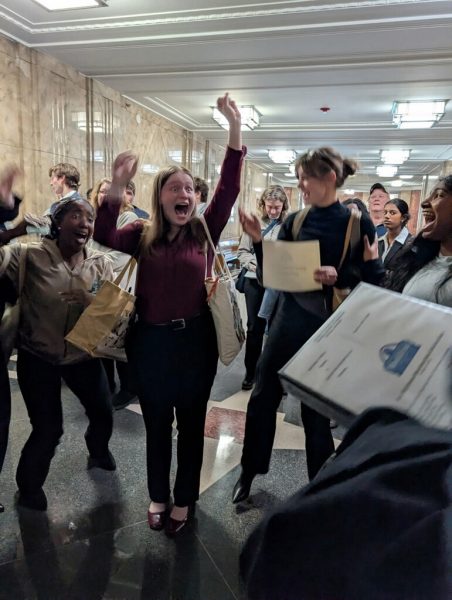
“I would go home, eat, get dressed, do my hair and then go to the courthouse. We’d have to arrive an hour before. Everyone reviews their depositions and practices their crosses and directs,” Lee said.
The Mock Trial team’s performance led them to the state competitions, where they competed against 16 of the best teams in the state.
“It’s super interesting to go up against those stronger teams, and just be in the courtroom during a good trial. A good back-and-forth objection battle is always a fun thing to witness,” Piston said.
At State, the team received the number one seed going into the quarterfinals round. They ended up winning third place out of over 100 teams in the state.
“The fact that we were able to go so far is a testament, not just to the individual skill and dedication of every member, but also to the skill that it takes to work well together as a team. That is something to be proud of,” Lowder said.