


Sophomore Julian Wilson’s family history spans three states and two continents. It started with his grandfather, Mukundrai Gulabrai Parikh, who immigrated to Michigan from India in 1960.
According to Wilson’s mother, Shanti Parikh, her father’s departure was a milestone for the family.
“He used to tell a story where 50 to 60 people went to the airport to send him off,” Wilson’s mom said.
In the 1960’s, long-distance communication was difficult.
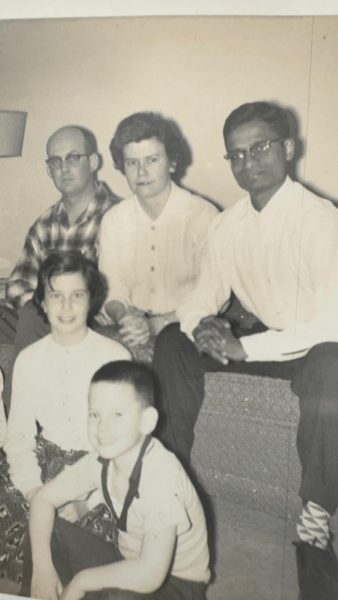
“There was a lag between when he landed and when he was able to get word to his family that he had safely arrived,” Wilson’s mom said. “Families were sending their children overseas, and it was seen as scary and as a world of possibilities.”
When Wilson’s grandfather left for India in September of 1960, he wore cotton clothes and sandals, and arrived in Michigan for the first time to find snow on the ground.
“It was his first time being in weather that was cold,” Wilson’s mom said.
In America, Wilson’s grandfather was not alone in figuring out how to live in a new country.
“He was in a program where he had a host family [that] he stayed with. They helped him get acclimated to the United States. That was very common; the host family was supposed to help them integrate,” Wilson’s mom said.
The host family provided an immersive experience that served as a cultural bridge for his grandfather, much like the internet would today.
“If he did not have the host family, it would have been harder to figure out how you do things in America, certain cultural ways. They helped him with getting appropriate clothing, with how to cook certain foods,” Wilson’s mom said.
His grandfather attended Michigan State University, the nation’s first land-grant institution, at a time when such schools were leading the way in STEM and international outreach. Through MSU, he was placed with a host family even before the Immigration and Nationality Act of 1965. This opened more doors for students like him.
“During that time, there were fewer immigrants who came [to America],” Wilson’s mom said. “He was part of a group who came to get his graduate degree [and to] get his master’s degree at a land grant university.”
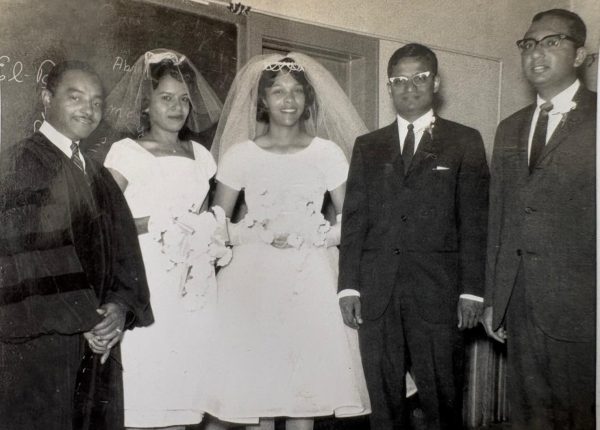
After graduating with a master’s in electrical engineering and doing an internship in Michigan, his grandfather got his first permanent job in New Jersey, where he met his wife, Eleanor Vernice Joyner. They married in 1962, before the Civil Rights Act and under Jim Crow laws.
“They found discrimination when they got married, because he was Indian, [and he] married my mom, who’s African American,” Wilson’s mom said. “On their [honeymoon], as they were driving, they weren’t able to get a hotel room in some of the smaller towns because my mom was black. So they had to spend one of the nights of their honeymoon in the car because it was too hard for them to get a hotel room.”
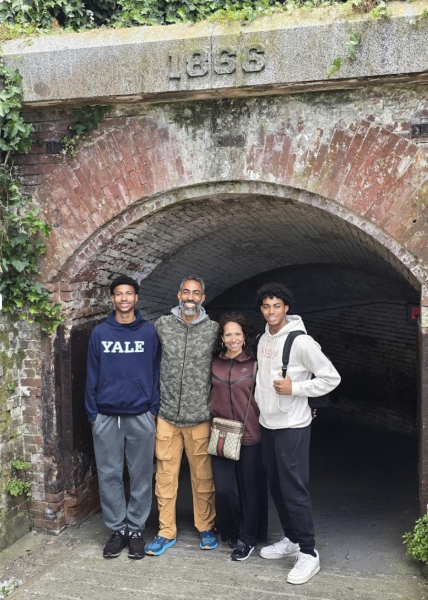
Years later, Wilson’s grandparents lived in the District of Columbia, Maryland, and the Virginia area with three daughters. While he was working at a company, he experienced difficulties.
“[In] his workplace, there were forms of subtle discrimination in terms of how far up he could go in management, because he had an accent [and because] he looked different. There were definitely forms of discrimination in terms of how high up that particular generation of Indians could get when it comes to management,” Wilson’s mom said.
Like many parents, Wilson’s grandparents chose to protect their children from hearing about life’s difficulties and provided them with everything they needed.
“They tried to make sure that we had access to really good schools [and] good education,” Wilson’s mom said. “They just sort of put their head[s] down, and they just dealt with it, and they kept moving forward. [But] they tried to surround themselves with friends who understood their experience.”
Wilson’s grandfather was a hard worker and dedicated to providing the best he could for his family. Even though he has passed away, he continues to affect his family’s generations.
“My family’s past has shaped me by teaching me the value of hard work and perseverance. [My grandfather’s] journey reminds me of the sacrifices made to create better opportunities for future generations. Knowing his story motivates me to appreciate my family’s history and stay driven in my own goals,” Wilson said.





Devika Parikh • Mar 8, 2026 at 4:29 pm
Lovely article. Thank you so much for sharing this inspiring story about my family 🥹❤️❤️