

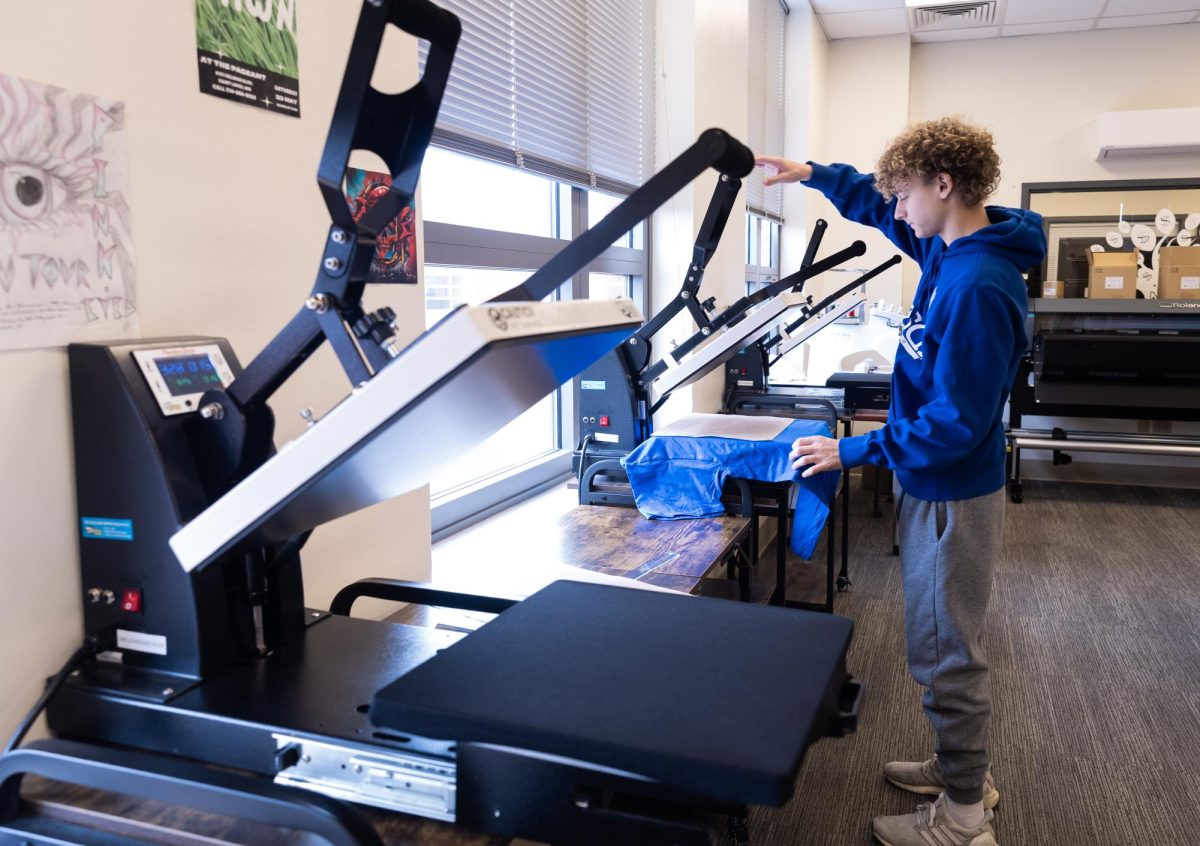
Algebra teacher Michelle Kondracki and business teacher James Maddock are breathing new life into the school store, Trackside Threads. By combining the math and business curricula, they have created a live-learning environment for freshman students. The new store debuts as an apparel-only boutique, serving as the foundation for a future larger operation.
The class that runs the store, called AMPED, alternates between business on A days and math on B days, with planning integrated. Both teachers consistently weave each other’s expertise into their lessons, providing students with a cohesive, real-world perspective.
“I’ll give Mr. Maddock a heads-up: ‘Hey, we’re doing exponentials.’ Then, we will think about some business exponential situations so we can help them in the class with some tidbits to add to the lesson,” Kondracki said.
When Maddock teaches business concepts such as inflation, Kondracki incorporates algebra skills.
“I[‘ll be] like, ‘Hey guys, this is how you type it into the calculator,’ [I] make sure it’s following the order of operations,” Kondracki said. “We include each other’s voices when appropriate.”
One thing Kondracki took to heart about the program is understanding that you do not have to be a master of your opposite content.
“We’ve both taken that willingness to learn,” Kondracki said. “Every day in business since it’s the first year, I’m learning something new. But after the lesson, I’m in a position [to] help the students. I think that [Mr. Maddock] would say the same about math.”
Maddock has enjoyed seeing how a business-related problem is actually an algebraic equation without realizing it.
“We’re answering that question of when am I ever going to need this? Which a lot of people ask when they’re in math and science classes. We’re actually showing the real-world applications of it, which is really cool,” Maddock said.
Freshman Birk Hoette learned that AMPED was a business course and wanted to learn more.
“We get to learn about different kinds of marketing, and I learn how to sell products,” Hoette said. “It helps with the math side when we do math examples in business or business examples in math. We calculate the cost of business income in our business class, and the math helps with that.”
Community members share their design inspirations and visions with the AMPED class, and the students bring them to life through Trackside Threads.
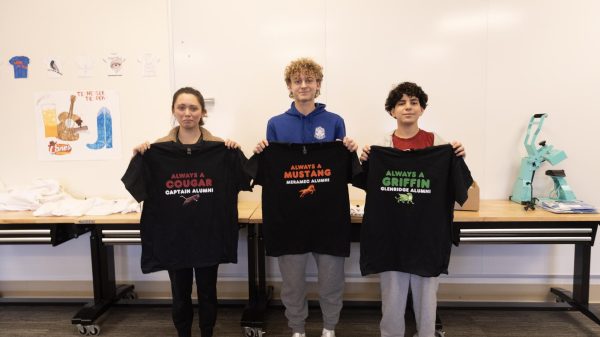
(Paisley McGill)
“The cool thing is, while we do incorporate some algebra with the business side of it, the students are still learning a lot of the basic business principles that we teach in Intro to Business,” Maddock said.
The district purchased four heat presses, an embroidery machine, a vinyl printer, and a direct-to-film transfer printer. In one semester, they sold $14,000 in product.
“In one semester, we have paid off two of the heat presses thus far,” Maddock says, “and are expected to pay off one more by the end of the school year.”
For freshman Sarah Larson, daily time with her teacher has been beneficial for building relationships.
“Having time with both teachers every day makes it so easy to ask questions, and the teachers can get to know us better, too. That’s a good part of having the AMPED program,” Larson said.
As orders roll in, Kondracki and Maddock get the students ready to make the products while continuing learning the algebra and business curriculum
“We always start each class with a rundown of the jobs we are finishing or starting. If we are starting a job, we talk about the placement of the designs on the apparel and see if the students have any questions,” Maddock said. “We then split the class into two groups, with one group pressing shirts and the other group receiving a lesson about business. Each group has assigned roles to complete that day. About halfway through the class, the groups swap.”
Kondracki and Maddock are working to make their students more confident in their algebra and business skills.
“[There are] students who’ve grown since the first week of school, when we asked if they are a collaborative person [because] we didn’t really know,” Kondracki said. “They’re a really collaborative class. Seeing them grow to be more collaborative people, we don’t want to make this class where some people can’t take it, because we want all students to be more collaborative, to be creative thinkers.”














Danée Jones • Mar 27, 2026 at 5:26 pm
Great article Paisley!! This is an awesome way to integrate learning in with the real world. Thank you for sharing.
Danée Jones • Mar 27, 2026 at 5:25 pm
Great article Paisley!! This is an awesome way to integrate learning in with the real world. Thank you for sharing.